

With chatbots and AI agents taking over most roles across the current industry, there is a rise in demand for AI developers. To become well versed in developing chatbots and AI agents, you need to understand how to design end-to-end agent workflows with RAG. Let us now deep dive into learning the basics.
Using a systematic approach to build an end-to-end multi agent workflow with RAG will help AI product development teams to perform effectively and efficiently. Say hello to a fast paced systematic approach that integrates various components and functionalities with RAG and multi-agent systems.
The objective is to establish a system that utilizes the strengths of various agents to boost productivity, optimize workflows, and promote collaboration. This guide will outline the key components, architecture, and implementation steps required to create a robust RAG multi-agent application. Initially, we will examine the fundamentals before delving into how to design workflows using RAG.
Understanding RAG and Multi-agent Systems
Retrieval-Augmented Generation (RAG) is a framework that merges the functionalities of retrieval-based systems with generative models. It enables the application to retrieve pertinent information from a knowledge base or external sources and utilize that information to produce contextually rich responses. This is especially beneficial in situations where current information is essential.
Multi-agent systems are composed of several autonomous agents that communicate with one another to accomplish specific objectives. Each agent can be tailored for distinct tasks, allowing the system to manage complex processes more effectively. In the realm of AI product development, agents can be crafted to oversee tasks such as data analysis, user engagement, and content creation.
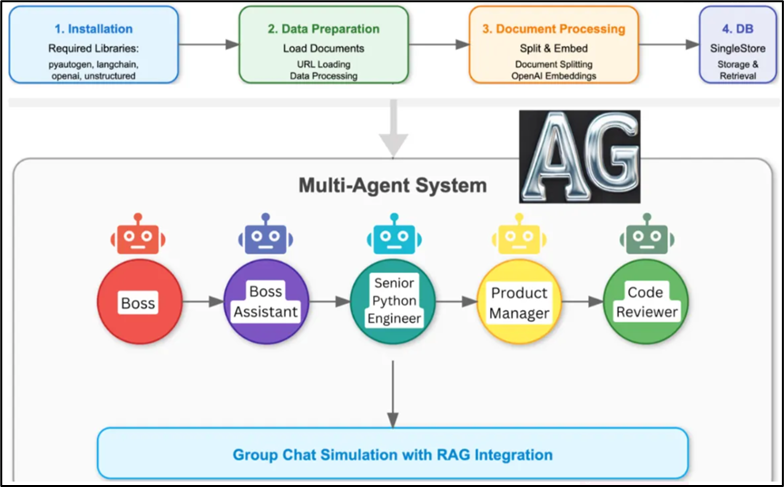
How to Design End-to-end Agent Workflows with RAG
Creating comprehensive agentic RAG workflows requires advancing from basic retrieval methods to developing autonomous, multi-step systems that utilize LLMs for reasoning, planning, and tool usage. Essential elements consist of smart query reformulation, semantic retrieval, context-sensitive generation, and ongoing assessment, typically overseen through orchestration frameworks such as LangGraph, n8n, or Langflow. Here are the steps involved in designing end-to-end agent workflows with RAG.
- Intelligent Query Agent: Instead of directly searching based on user input, an agent evaluates the query, breaks down complex questions into simpler sub-questions, and reformulates them to enhance search outcomes.
- Heterogeneous Knowledge Retrieval: The agent selects from various tools: vector search for semantic insights, SQL agents for structured information, or web search for up-to-date data.
- Agentic Orchestrator (Orchestration): By utilizing frameworks like LangGraph or CrewAI, agents function in loops to progressively refine answers, as opposed to a straightforward, one-time retrieval method. Use a LangGraph workflow to create the best agent workflow.
- Use a LangGraph workflow to create the best agent workflow.
- Ingest & Structure Data: Import documents, implement chunking techniques (such as recursive or semantic), and create embeddings in a vector database. Set Up Agent Toolkit: Specify tools for the agent (for instance, retriever, calculator, web_search).
- Define Agent Persona Establish the agent's role, objectives, and background to enhance reasoning, employing a high-performance model (like GPT-4 or Claude 3).
- Execute Thought Process (Thought -> Action -> Observation): Thought : The agent assesses the query.
- Action: The agent opts to utilize a retrieval tool. Observation: The agent reviews the context obtained. Refinement: If the information is inadequate, the agent rephrases the query and continues the process (looping). Synthesize and Respond: Produce the final answer after confirming that relevant data has been gathered.
- Active Validation: In contrast to conventional RAG, which fetches data a single time to generate a response, Agentic RAG enables agents to "think" by verifying the retrieved context against the user's query.
- Error Reduction: Data from Cyfuture indicates that Agentic RAG can decrease error rates by as much as 78% when compared to traditional RAG benchmarks.
- Fact-Checking Loop: Agents possess the capability to independently identify inaccuracies and can re-query the knowledge base if the initial data retrieval does not yield adequate information.
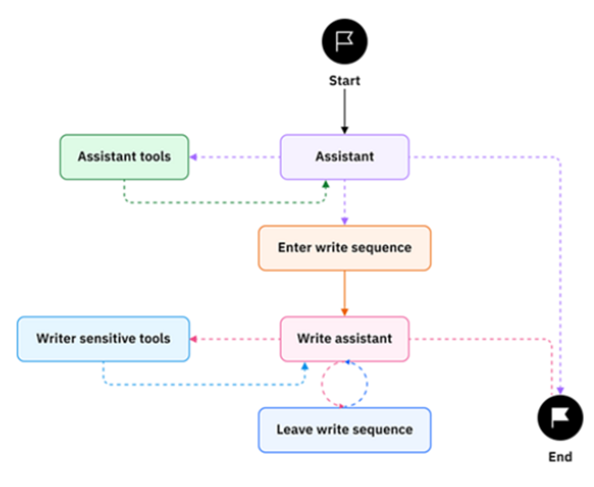
Implementing RAG with Astra DB
You can use DataStax Astra DB with Astra Vectorizer/NVIDIA to perform vector database configuration. This helps in collection creation for recipe storage with document pipeline processing.
Creating a multi-agent system
You can create a multi-agent system by managing the overall workflow with a primary agent. Use RAG integration to query the vector database. Finally, use web search fallback with DuckDuckGo for finding missing information.
Implementing a Fallback Mechanism and Final Testing
You can receive the user query, search the vector database, and combine and format the results accordingly. Design the fallback mechanism to return a comprehensive response. Once you are done, you need to use Langflow, a Python based virtual framework to create a virtual workflow and integrate it with multiple tools.
Advantages of Designing Agent Workflows with RAG
Designing agent workflows with RAG gives you an edge as it makes you stand out from the competition. Here are a few advantages of designing agent workflows with RAG.
Now that you have understood the nuances of designing end-to-end agent workflows with RAG, you can take a deep dive into real-time applications with guidance from our mentors at Eduinx. As a leading edtech institute in India, Eduinx has a team of non-academic mentors with over decades of industry-relevant experience. We will help you achieve your AI goals and land your dream job at a good salary package through placement assistance. Get in touch with us to know more about our applied generative AI course.

Akassh vijay
Share on Social Platform:
Subscribe to Our Newsletter
Recommended Articles

AI Product Managers: Roles, Responsibilities, and Future Scope
Did you know that a highly skilled product manager has the ability to increaseLearn More

Generative AI: A Deep Dive
Did you know that 75% of gen AI users are looking to Learn More